 The Lemon Index
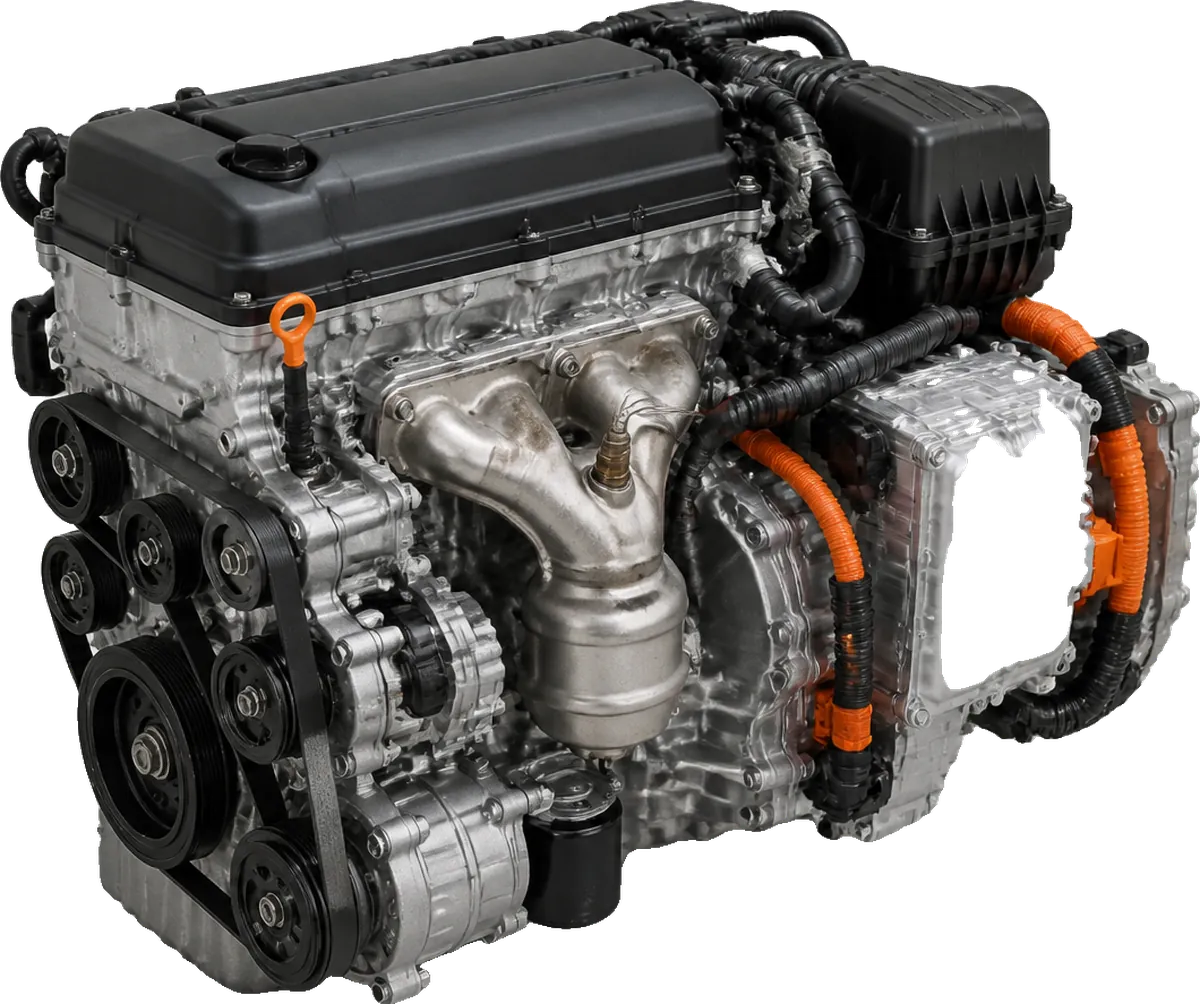
The 2.0 L inline-4, hybrid in the Honda CR-V and Honda Accord, model years 2014–2025. Owners filed 2,261 complaints about cars with it (matched by VIN); 16% name the engine, #33 of the 51 everyday engines we track (1 = the most).
Known issues, checked against owner complaints
Problems owners of cars with this engine name much more often than owners of the other 50 everyday engines we track (at least 1.5× the median, and 10+ complaints):
- The hybrid system and its battery. 27 of 2,261 owner complaints (1.2%) mention the hybrid battery, inverter or hybrid system, against a median of under 0.1% for the other 50 everyday engines we track.
Also often talked about, but not standing out in complaints to NHTSA: sudden loss of power (235 of 2,261, 10%, peers 13%). That doesn't mean it never happens, only that owners rarely file it with the government.
What YouTube owners say
Average owner tone 54/100 across 10 model years, from 119 videos about this engine and its cars (#97 of 409 engines with a YouTube study).
Most-watched videos
- Should You Buy a 2023 Honda CR-V Hybrid? Thorough Review by A Mechanic 1,188,840 views
- Understanding the Honda CR-V Hybrid E-Drive 947,470 views
- Honda CR-V Hybrid vs. Toyota RAV4 Hybrid vs. Mazda CX-50 Hybrid | Small Hybrid SUV Comparison Test 737,011 views
- Road Tripping The 2025 Honda Accord Hybrid (800 Miles!) - What’s it Like? 640,509 views
- 2018 Honda Accord Hybrid – The Most Efficient Accord Ever? 483,919 views
Counted from video titles and captions: praise words against trouble words, weighted by views. Videos only count when the title names this engine or a car that had only this engine in those years.
Cars with this engine Tap a year for that car's full report.
Model years from NHTSA VIN decoding of owner complaints. Only years we have a car page for.
Owner complaints by model year
How to read this chart
Counts of complaints filed so far. Older cars have had longer to collect them, and popular cars draw more because more were sold: no one reports sales by engine, so there's no per-car rate. Compare the shares below instead.
By car
| Car | Model years matched | Complaints | Name the engine |
|---|---|---|---|
| Honda CR-V | 2020–25 | 1,252 | 16% |
| Honda Accord | 2014–25 | 1,009 | 17% |
“Name the engine” = the share of that car's VIN-matched complaints that list the engine as a problem area.
What owners complain about
Share of this engine's complaints that name each area (one complaint can name several).
What owners write
| Complaints that | Count | Share | Median, other everyday engines |
|---|---|---|---|
| Say the engine stalled, shut off or lost power | 235 | 10% | 13% |
| Mention a head gasket | 86 | 3.8% | 0.1% |
| Mention coolant loss or overheating | 66 | 2.9% | 1.2% |
| Mention fire, flames or smoke | 65 | 2.9% | 3.3% |
| Mention a misfire | 55 | 2.4% | 0.5% |
| Say the engine knocked, seized or failed | 50 | 2.2% | 2.7% |
| Mention a spark plug | 34 | 1.5% | 0.4% |
| Mention the hybrid battery, inverter or hybrid system | 27 | 1.2% | under 0.1% |
| Mention a lifter, rocker or ticking | 7 | 0.3% | 0.3% |
| Mention the water pump | 7 | 0.3% | 0.1% |
Counted from the owner's own words in each complaint (all of the car, not only the engine). A share, not a failure rate.
When problems show up
Half of the owners who gave a mileage reported the problem between 5,000 and 42,332 miles; the middle report was at 15,000 miles (362 complaints with a mileage).
Recalls that name this engine
25V785000 Nov 2025 Electrical System Accord 2023, 2024, 2025
Honda (American Honda Motor Co.) is recalling certain 2023-2025 Honda Accord Hybrid vehicles. Due to a software error, the integrated control module (ICM) central processing unit (CPU) may reset while driving, causing a loss of drive power.
Fix. Dealers will reprogram the ICM CPU software, free of charge. Owner notification letters were mailed January 6, 2026. Owners may contact Honda's customer service at 1-888-234-2138. Honda's number for this recall is TN2. Vehicle Identification Numbers (VINs) involved in this recall will be searchable on NHTSA.gov beginning November 18, 2025.
24V745000 Oct 2024 Electrical System CR-V 2023
Honda (American Honda Motor Co.) is recalling certain 2023 Honda CR-V Hybrid vehicles. The high voltage battery modules may have been manufactured incorrectly, which can cause the battery terminal or busbar to break and spark.
Fix. Dealers will replace the battery module, free of charge. Owner notification letters were mailed November 27, 2024. Owners may contact Honda Customer Service at 1-888-234-2138. Honda's number for this recall is HJR.
20V798000 Dec 2020 Electrical System CR-V 2020
Honda (American Honda Motor Co.) is recalling certain 2020 CR-V Hybrid, Accord Hybrid, and 2020-2021 Insight vehicles. The DC-DC converter may shut down and prevent the 12-volt battery from recharging, possibly resulting in a loss of drive power.
Fix. Honda will notify owners, and dealers will update the power converter unit (PCU) software, free of charge. The recall began February 12, 2021. Owners can contact Honda customer service at 1-888-234-2138. Honda's number for this recall is K9E.
NHTSA recalls on these cars and model years whose text names this engine (its size or name). The rest (brakes, air bags, wiring ...) are on each car year's page.
In owners' words
The steering wheel is sticky when driving this is a common issue on some model Hondas but it makes the vehicle over correct due to the steering wheel sticking. It’s been going on for a while we took it to the dealership and got new tires and a wheel alignment but the issue is still there
2024 owner · NHTSA complaint 11777788
The contact owns a 2025 Honda CR-V. The contact stated that while driving at 7 MPH, the passenger's side exterior rear-view mirror independently fractured. The contact referenced an unknown recall with a similar failure description; however, the VIN was not under recall.
2025 owner · NHTSA complaint 11777453
Windshield wipers and washer do not clean windshield off leaving a large area not cleared off
2025 owner · NHTSA complaint 11776414
Against the other everyday engines
| Engine | Years | Complaints | Name the engine | Stalled or lost power | Burning oil | Recalls naming it |
|---|---|---|---|---|---|---|
| 1.5 EcoBoost | 2014–25 | 5,627 | 66% | 15% | 0.2% | 2 |
| 6.2 V8 (Gen V) | 2014–25 | 7,233 | 65% | 24% | 2.2% | 2 |
| Skyactiv-G 2.5T | 2016–25 | 632 | 56% | 8.4% | 9.0% | 0 |
| 2.4 Theta II | 2010–22 | 21,564 | 51% | 20% | 8.1% | 8 |
| 2.4 Ecotec | 2010–17 | 6,098 | 51% | 21% | 18% | 0 |
| 3.0 EcoDiesel | 2014–23 | 2,874 | 50% | 24% | 0.2% | 7 |
| 3.3 Lambda II | 2013–21 | 3,258 | 50% | 17% | 5.9% | 2 |
| 2.0 EcoBoost | 2012–25 | 9,748 | 48% | 12% | 0.1% | 0 |
| 2.0T Theta II | 2011–22 | 3,327 | 44% | 18% | 4.7% | 2 |
| M57 diesel | 2009–13 | 316 | 40% | 16% | 0.3% | 4 |
| 1.4 Turbo | 2011–22 | 3,928 | 39% | 17% | 0.9% | 2 |
| 2.0 diesel | 2014–18 | 223 | 37% | 24% | under 0.1% | 2 |
| 2.4 Tigershark | 2014–22 | 9,634 | 35% | 34% | 4.5% | 5 |
| i-FORCE MAX | 2022–25 | 307 | 34% | 15% | under 0.1% | 0 |
| 1.5 Turbo | 2016–25 | 4,477 | 33% | 27% | 0.3% | 1 |
| EA888 2.0T | 2009–25 | 7,455 | 29% | 16% | 3.6% | 5 |
| A25A | 2018–25 | 2,988 | 26% | 12% | under 0.1% | 1 |
| 3.8 V6 (G6DA / G6DJ) | 2006–16 | 2,098 | 26% | 16% | 0.6% | 0 |
| 1.5 Turbo | 2017–22 | 8,078 | 25% | 13% | 0.2% | 0 |
| J35 V6 | 2003–25 | 24,081 | 24% | 14% | 0.9% | 4 |
| Skyactiv-G 2.5 | 2014–25 | 2,634 | 22% | 11% | 2.7% | 1 |
| 2.7 Turbo | 2019–25 | 1,098 | 22% | 12% | 0.5% | 0 |
| 2AZ-FE | 2001–09 | 7,176 | 22% | 3.7% | 8.6% | 0 |
| 3.0 TFSI | 2009–19 | 693 | 22% | 6.6% | 6.5% | 0 |
| 5.4 Triton | 2005–14 | 3,952 | 21% | 15% | 0.1% | 3 |
| 5.7 HEMI | 2003–24 | 23,907 | 19% | 23% | 0.1% | 6 |
| QR25DE | 2002–20 | 16,167 | 19% | 14% | 1.5% | 4 |
| 5.3 V8 (Gen V) | 2014–25 | 13,198 | 18% | 13% | 0.5% | 3 |
| 3.6 Pentastar | 2011–25 | 34,649 | 18% | 16% | 0.4% | 9 |
| 6.0 Two-Mode Hybrid | 2009–12 | 113 | 18% | 18% | under 0.1% | 0 |
| 2.3 EcoBoost | 2015–25 | 3,983 | 16% | 9.9% | 0.1% | 12 |
| 3.8 Lambda II | 2020–25 | 4,433 | 16% | 8.0% | 5.6% | 0 |
| 2.0 hybrid | 2014–25 | 2,261 | 16% | 10% | under 0.1% | 3 |
| FB20 | 2012–25 | 2,336 | 15% | 8.2% | 1.7% | 0 |
| 3.6 V6 | 2009–23 | 14,218 | 14% | 14% | 0.1% | 1 |
| K24 | 2002–19 | 15,084 | 14% | 5.1% | 1.6% | 0 |
| 2GR-FKS | 2016–24 | 3,775 | 12% | 11% | 0.2% | 2 |
| 3.5 Cyclone V6 | 2007–19 | 21,316 | 12% | 11% | 0.1% | 0 |
| VQ35 V6 | 2002–25 | 12,617 | 12% | 11% | 0.2% | 1 |
| 3UR-FE | 2007–21 | 1,378 | 12% | 8.8% | 0.4% | 0 |
| 4.6 V8 | 2000–11 | 8,651 | 12% | 6.9% | under 0.1% | 3 |
| FB25 | 2011–25 | 9,863 | 11% | 6.2% | 1.5% | 0 |
| 2AR-FE | 2009–18 | 4,675 | 11% | 6.6% | 1.3% | 1 |
| 2GR-FE | 2005–18 | 8,682 | 10% | 3.5% | 0.3% | 0 |
| 2.0 hybrid | 2013–20 | 995 | 10% | 12% | 0.1% | 0 |
| 3.8 V6 | 2007–11 | 7,877 | 9% | 17% | 0.5% | 0 |
| 5.3 V8 (Gen IV) | 2007–14 | 9,241 | 8% | 4.5% | 1.3% | 0 |
| 1GR-FE | 2003–24 | 5,757 | 7% | 4.0% | under 0.1% | 0 |
| 2.5 hybrid | 2012–25 | 1,923 | 7% | 5.8% | 0.1% | 2 |
| 4.8 V8 | 2007–13 | 726 | 6% | 4.8% | 0.1% | 0 |
| 2.3 Duratec | 2001–11 | 639 | 4% | 2.5% | under 0.1% | 0 |
Shares of each engine's own complaints, matched by VIN. They show what owners complain about, not how often engines break.
Quick answers
Is the Honda 2.0 hybrid (i-MMD) reliable?
No one reports sales by engine, so there's no per-car score. Of the 2,261 complaints owners filed about cars with it, 16% name the engine, #33 of the 51 everyday engines we track (1 = the most). 27 (1.2%) mention the hybrid battery, inverter or hybrid system, against under 0.1% for the other engines.
What cars have the Honda 2.0 hybrid (i-MMD)?
In our data: the Honda CR-V and Honda Accord, model years 2014–2025, matched by the VIN in each owner complaint.
What are the most common 2.0 hybrid problems?
In owner complaints to the government: steering, electrical, engine.
How many recalls name the 2.0 hybrid?
3 NHTSA recalls on these cars name it.
Complaints: NHTSA owner complaints filed under each car's own NHTSA names (the same ones its car pages count), all years filed, one per complaint number. Engine: decoded from the complaint's VIN with NHTSA's vPIC decoder (displacement, cylinders, engine model, turbo, hybrid) and the engine maker's model years; a VIN that doesn't decode to exactly one engine is left out. Older cars have had more years to collect complaints, and popular cars draw more because more were sold. Source: NHTSA owner complaints (FLAT_CMPL + COMPLAINTS_RECEIVED_2025-2026), received through 20261115; engines: NHTSA vPIC VIN decoder (batch); NHTSA recalls API. Engine names and model years: Honda.