 The Lemon Index
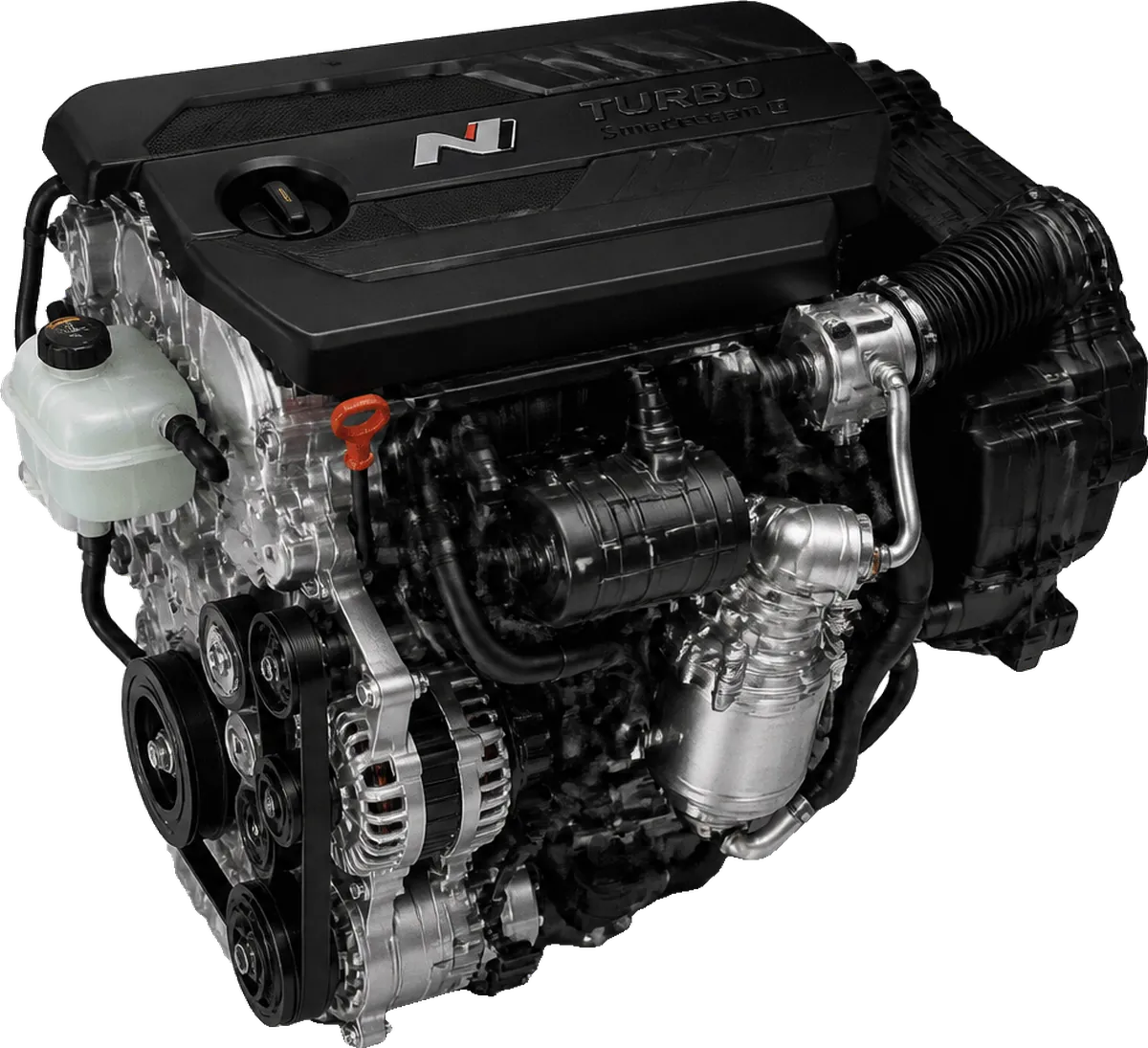
Hyundai's 2.0 L turbo inline-4 in the Veloster N, Elantra N and Kona N, model years 2019–2026. YouTube likes the 2021 best. Also in the Kia Sportage, Kia Optima, Hyundai Sonata, Hyundai Santa Fe and more (below).
Liked, but check the recalls: YouTube owner tone 60/100, #6 of 165 engines with a YouTube study (in the top third); 2 engine-related recalls on record.
In everyday cars, matched by VIN
Owners filed 3,325 complaints about the Hyundai Sonata, Kia Optima, Hyundai Santa Fe, Kia Sportage and Kia Sorento with the 2.0T Theta II (model years 2011–2022, engine read from each complaint's VIN). 44% name the engine, #8 of the 39 everyday engines we track (1 = the most).
Known issues, checked against owner complaints
Problems owners of cars with this engine name much more often than owners of the other 38 everyday engines we track (at least 1.5× the median, and 10+ complaints):
- Engine knock and seizure (rod bearings). 558 of 3,325 owner complaints (17%) say the engine knocked, seized or failed, against a median of 2.7% for the other 38 everyday engines we track.
Codes P0172 and P016B. Oil has fuel in it due to high pressure fuel pump leaking. Possible premature engine failure or fire. This is a 2020 santa fe limited 2.0T.
2020 owner · NHTSA complaint 11766360 - Engine fires. 220 of 3,325 owner complaints (6.6%) were filed with a fire reported, against a median of 1.2% for the other 38 everyday engines we track.
- The turbo. 334 of 3,325 owner complaints (10%) mention the turbo, against a median of under 0.1% for the other 38 everyday engines we track.
The turbo system on the car burns oil at a rapid rate. Had to pay $4000 to replace and still continues to give me problems and check engine light. Violates lemon law. Had replaced in September but was giving me problems well before and finally took it to the dealer for repair
2020 owner · NHTSA complaint 11691126
| Car | Model years matched | Complaints | Name the engine |
|---|---|---|---|
| Hyundai Sonata | 2011–19 | 1,092 | 36% |
| Kia Optima | 2011–20 | 970 | 42% |
| Hyundai Santa Fe | 2013–20 | 858 | 51% |
| Kia Sportage | 2011–22 | 205 | 59% |
| Kia Sorento | 2016–18 | 200 | 52% |
Owner complaints by model year
What owners complain about
2 recalls on these cars name the engine
20V100000 Feb 2020 Fuel System, Gasoline Optima 2013, 2014
Kia Motors America (Kia) is recalling certain 2013-2014 Optima vehicles equipped with 2.4L Gasoline Direct Injection (GDI) or 2.0L GDI Turbo engines. The low pressure fuel hose may deteriorate and crack over time due to heat generated within the engine compartment.
Fix. Kia will notify Owners, and Dealers will inspect the low pressure fuel hose for damage or leaking, replacing it as necessary. If no damage or leaking is found, a heat-protective tape will be installed. Repairs will be performed free of charge. The recall began June 12, 2020. Owners may contact Kia customer service at 1-800-333-4542. Kia's number for this recall is SC187.
19V539000 Jul 2019 Forward Collision Avoidance Optima 2019
Kia Motors America (Kia) is recalling certain 2019 Optima vehicles equipped with Gamma 1.6L Turbo-GDI or Theta II 2.0L Turbo-GDI engines. A software error in the Forward Collision-Avoidance Assist (FCA) system may cause the braking assist function to not engage when a stationary vehicle is detected.
Fix. Kia will notify owners, and dealers will update the FCA software, free of charge. The recall began August 27, 2019. Owners may contact Kia customer service at 1-800-333-4542. Kia's number for this recall is SC179.
Against the other everyday engines
| Engine | Years | Complaints | Name the engine | Stalled or lost power | Burning oil | Recalls naming it |
|---|---|---|---|---|---|---|
| 1.5 EcoBoost | 2014–25 | 5,622 | 66% | 15% | 0.2% | 2 |
| 6.2 V8 (Gen V) | 2014–25 | 7,219 | 65% | 24% | 2.2% | 2 |
| 2.4 Theta II | 2010–22 | 21,551 | 51% | 20% | 8.1% | 8 |
| 2.4 Ecotec | 2010–17 | 6,096 | 51% | 21% | 18% | 0 |
| 3.0 EcoDiesel | 2014–23 | 2,871 | 50% | 24% | 0.2% | 7 |
| 3.3 Lambda II | 2013–21 | 3,254 | 50% | 17% | 5.9% | 2 |
| 2.0 EcoBoost | 2012–25 | 9,735 | 48% | 12% | 0.1% | 0 |
| 2.0T Theta II | 2011–22 | 3,325 | 44% | 18% | 4.8% | 2 |
| 1.4 Turbo | 2011–22 | 3,926 | 39% | 17% | 0.9% | 2 |
| 2.4 Tigershark | 2014–22 | 9,631 | 35% | 34% | 4.5% | 5 |
| 1.5 Turbo | 2016–25 | 4,471 | 33% | 27% | 0.3% | 1 |
| EA888 2.0T | 2009–25 | 7,443 | 29% | 16% | 3.7% | 5 |
| A25A | 2018–25 | 2,979 | 26% | 12% | under 0.1% | 1 |
| 1.5 Turbo | 2017–22 | 6,390 | 26% | 14% | 0.2% | 0 |
| J35 V6 | 2003–25 | 24,038 | 24% | 14% | 0.9% | 4 |
| Skyactiv-G 2.5 | 2014–25 | 2,631 | 22% | 11% | 2.7% | 1 |
| 2.7 Turbo | 2019–25 | 1,090 | 22% | 12% | 0.5% | 0 |
| 2AZ-FE | 2001–09 | 7,176 | 22% | 3.7% | 8.6% | 0 |
| 5.4 Triton | 2005–14 | 3,952 | 21% | 15% | 0.1% | 3 |
| 5.7 HEMI | 2003–24 | 23,895 | 19% | 23% | 0.1% | 6 |
| QR25DE | 2002–20 | 16,161 | 19% | 14% | 1.5% | 4 |
| 5.3 V8 (Gen V) | 2014–25 | 13,191 | 18% | 13% | 0.5% | 3 |
| 3.6 Pentastar | 2011–25 | 34,634 | 18% | 16% | 0.4% | 9 |
| 2.3 EcoBoost | 2015–25 | 3,975 | 16% | 9.9% | 0.1% | 12 |
| 3.8 Lambda II | 2020–25 | 4,423 | 16% | 8.0% | 5.6% | 0 |
| FB20 | 2012–25 | 2,336 | 15% | 8.2% | 1.7% | 0 |
| 3.6 V6 | 2009–23 | 14,214 | 14% | 14% | 0.1% | 1 |
| K24 | 2002–19 | 15,062 | 14% | 5.1% | 1.6% | 0 |
| 2GR-FKS | 2016–24 | 3,758 | 12% | 11% | 0.2% | 2 |
| 3.5 Cyclone V6 | 2007–19 | 21,313 | 12% | 11% | 0.1% | 0 |
| VQ35 V6 | 2002–25 | 12,613 | 12% | 11% | 0.2% | 1 |
| 3UR-FE | 2007–21 | 1,377 | 12% | 8.8% | 0.4% | 0 |
| FB25 | 2011–25 | 9,853 | 11% | 6.2% | 1.5% | 0 |
| 2AR-FE | 2009–18 | 4,673 | 11% | 6.6% | 1.3% | 1 |
| 2GR-FE | 2005–18 | 8,680 | 10% | 3.5% | 0.3% | 0 |
| 3.8 V6 | 2007–11 | 7,877 | 9% | 17% | 0.5% | 0 |
| 5.3 V8 (Gen IV) | 2007–14 | 9,241 | 8% | 4.5% | 1.3% | 0 |
| 1GR-FE | 2003–24 | 5,757 | 7% | 4.0% | under 0.1% | 0 |
| 4.8 V8 | 2007–13 | 726 | 6% | 4.8% | 0.1% | 0 |
Counts and shares, not failure rates: no one reports sales by engine. Complaints: NHTSA owner complaints filed under each car's own NHTSA names (the same ones its car pages count), all years filed, one per complaint number. Engine: decoded from the complaint's VIN with NHTSA's vPIC decoder (displacement, cylinders, engine model, turbo, hybrid) and the engine maker's model years; a VIN that doesn't decode to exactly one engine is left out. Older cars have had more years to collect complaints, and popular cars draw more because more were sold. Source: NHTSA owner complaints (FLAT_CMPL + COMPLAINTS_RECEIVED_2025-2026), received through 20261111; engines: NHTSA vPIC VIN decoder (batch).
Everyday cars with this engine Tap a year for that car's full report.
- Kia Sportage201120122013201420152016201720182019202020212022
- Kia Optima2011201220132014201520162017201820192020
- Hyundai Sonata201120122013201420152016201720182019
- Hyundai Santa Fe20132014201520162017201820192020
- Hyundai Elantra N2022202320242025
- Hyundai Veloster N2019202020212022
- Kia Sorento201620172018
- Hyundai Kona N20222023
Model years from EPA version lists and NHTSA VIN decoding of owner complaints. Only years we have a car page for.
Reliability by year
YouTube videos are most positive about the 2021 (67) and least about the 2025 (56); neighboring years share many of the same videos, so small gaps mean little.
How we count: owner complaints only where the car's name and year leave no doubt; YouTube tone from videos that name this engine or its cars. How we count
Owner complaints (NHTSA) are filed by model and year, not engine. We count one for this engine only when the model name and year had no other engine (e.g. "488 GTB", "GT-R"), or when the owner's own words name a version that had only this engine that year (Z06, ZR1, Hellcat, GT500 ...). They cover the whole car (wheels, air bags, electrics ...), not only the engine, and none of them is a failure rate. We chart them only for engines with 30 or more, over 3 or more years. YouTube tone = how positive the videos are, 0–100, from titles and transcripts (praise vs trouble words, the title counts 3 times), weighted by views; a year needs at least 3 videos' worth. A video counts for this engine when its title names the engine or a car that only had this engine in the years it names; a video whose title names no model year counts toward every year of that car, so neighboring years share most of their videos.
All the numbers, year by year
| Year | Cars | Owner complaints | YouTube says | Recalls |
|---|---|---|---|---|
| 2019 | Veloster N | 4 | 59 (44 videos) | 2 |
| 2020 | Veloster N | 3 | 64 (32 videos) | 2 |
| 2021 | Veloster N | 18 | 67 (34 videos) | 3 |
| 2022 | Veloster N, Elantra N, Kona N | 61 | 59 (103 videos) | 5 |
| 2023 | Kona N, Elantra N | 18 | 57 (63 videos) | 1 |
| 2024 | Elantra N | 1 | 57 (67 videos) | 0 |
| 2025 | Elantra N | 7 | 56 (60 videos) | 1 |
| 2026 | Elantra N | 1 | 59 (57 videos) | 0 |
Recalls on cars with this engine 6
2 of them are about the engine, fuel, cooling or powertrain. They come first.
24V528000 Fuel System, Gasoline · Hyundai Elantra N, Hyundai Kona N, Hyundai Veloster N 2019–23
The fuel pump may fail, which can result in a loss of drive power.
22V746000 Power Train · Hyundai Elantra N, Hyundai Kona N, Hyundai Veloster N 2021–22
The vehicle's "fail-safe" limited-mobility drive mode may be impaired, when prompted by a transmission oil pump malfunction, which can result in a complete l.
26V254000 Air Bags · Hyundai Elantra N 2025
The B-pillar impact sensors may have been misassembled, which can delay air bag deployment.
26V728000 Air Bags · Hyundai Veloster N 2019–22
A software error in the air bag control unit (ACU) may improperly deactivate the air bag system and seat belt pretensioners.
24V879000 Back Over Prevention · Hyundai Elantra N 2022
Due to a damaged printed circuit board, the rearview camera image may fail to display.
Show all 6
22V632000 Air Bags · Hyundai Elantra N 2022
The emblem on the cover of the driver's front air bag may not have been welded properly, which can result in the emblem detaching upon deployment.
NHTSA recalls by model and year. A recall counts here when every confirmed version of that model-year had this engine, or the recall names it. Check a car's VIN for its own open recalls.
Engine problems Hyundai told dealers about
Hyundai sent dealers 8 repair notes about the engine on these cars, including:
- Certain Elantra (CN7), Elantra N (CN7 N), Elantra (CN7A) vehicles may experience a thudding noise coming from…
- Some Elantra (CN7/CN7A), Elantra N (CN7 N) and Elantra Hybrid (CN7 HEV) vehicles may experience the following…
- Certain Elantra N (CN7 N), Kona N (OS N), and Veloster N (JS N) vehicles may have DTC P1326 set due to water…
NHTSA manufacturer communications (technical service bulletins), matched by model name and year like the complaints, engine-related ones only. A repair note is not a recall: ask a seller whether it was done.
Every US version with this engine
| Car and versions | Years |
|---|---|
| Hyundai Veloster N Veloster N · Hyundai Veloster, every year | 2019–22 |
| Hyundai Elantra N Elantra N · Hyundai Elantra, every year | 2022–26 |
| Hyundai Kona N Kona N · Hyundai Kona, every year | 2022–23 |
Engine code: G4KH. Power: 247–276 hp, factory figures. Versions and years: EPA (fueleconomy.gov). Sources: Hyundai Theta engine.
Quick answers
What cars have the Hyundai Theta II 2.0 turbo (G4KH) engine?
In the US: the Hyundai Veloster N, Hyundai Elantra N, Hyundai Kona N, model years 2019–2026. See the version table for each one.
Is the Hyundai Theta II 2.0 turbo (G4KH) reliable?
Mostly, if the recalls were done. YouTube owner tone 60/100, #6 of 165 engines with a YouTube study (in the top third); 2 engine-related recalls on record. Owners filed 113 complaints we can tie to it, about any part of the car. Its cars had 6 recalls (2 about the engine, fuel or powertrain). Have any used car inspected.
How much horsepower does the Hyundai Theta II 2.0 turbo (G4KH) make?
247–276 hp in factory figures, depending on the car.