 The Lemon Index
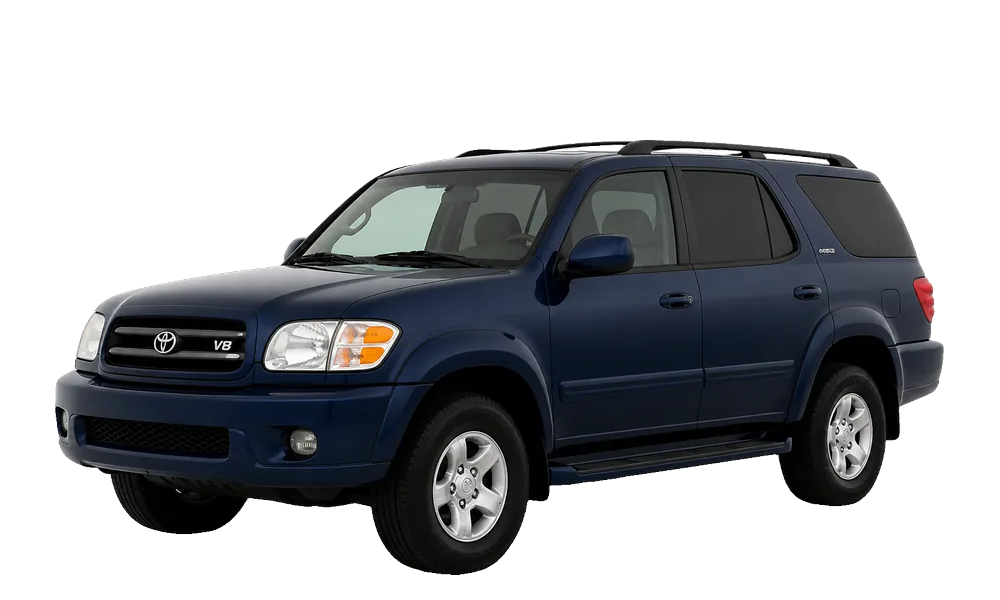 20042006
1st generation
Worse than average · most complaints: engine
47 owner complaints, first 3 years 15 mpg combined, EPA
Similar cars, same year
2005 Chevrolet Tahoe 712005 Ford Expedition 582005 Chevrolet Suburban 86
Lemon Index: 100 = the average car, lower is better.
What breaks most on the 2005 Toyota Sequoia
- Rust / frame corrosion27 complaintsmostly at 100,000–190,000 miles (161,000–306,000 km)
- Brake booster / hard pedal13 complaintsmostly at 69,000–107,000 miles (111,000–172,000 km)
- Engine stalling11 complaintsmostly at 77,000–116,000 miles (124,000–187,000 km)
Specific parts named in the 352 owner complaints filed with NHTSA for the 2005 Toyota Sequoia (all dates). Miles = the odometer owners typed in (middle half); cost = the repair bills owners wrote in those same complaints, in U.S. dollars. Owners' reports, not confirmed defects.
When problems show up
Most problems on this year showed up between 5,000 and 35,000 miles (8,000–56,000 km) (the middle half of the 29 complaints, of all 47 filed so far, that listed a mileage).
- At 60K, 100K and 150K miles (97K, 161K and 241K km) Past the range where most problems showed up: it has likely had them or dodged them, so repair records matter most.
This is when owners who had a problem reported it, not the odds that one car will have it.
Questions to ask the seller
- Were recalls 22E002000 (suspension), 19V741000 (airbags) and 18V883000 (airbags) done? It has 11 recalls in all. Ask for the dealer printout, or check the VIN.
- NHTSA has an open investigation into desiccated air bag inflator rupture. Has this car had that problem?
- Any oil burning, leaks or check-engine lights? Ask for oil-change records.
- Any clunks over bumps or uneven tire wear? Were struts, shocks or control arms replaced?
- Is the stability-control light off on a test drive?
- Toyota sent dealers 222 repair notes for this car. Was this one done: “Abnormal squeal noise from the engine accessory drive belt area, usually during cold start-up”?
From this year's own recalls, top problems, top repair bills and Toyota's repair notes. Recall repairs are free at any dealer.
How serious. Out of all 47 owner complaints filed so far (every year since it was sold, not just the first 3), owners reported:
“Average car” = what the same number of complaints would include at the rate across every model year we track. Owners report these themselves; NHTSA doesn't confirm the cause.
What owners complain about most. From owner complaints to the government.
Share of this year's owner complaints filed with NHTSA, not the share of cars that break. One complaint can name more than one area.
Check engine light on? Look up any code →
When owners reported problems. From owner complaints to the government.
Most owners who filed a complaint with NHTSA had 5K to 35K miles (8K to 56K km) on the car (29 of all 47 complaints filed so far listed the miles). This shows when people who had a problem reported it, not the odds that your car will have it.
In owners' words
Upon acceleration vehicle cabin fills with a sulfur (rotten egg) smell. Dealership states they cannot duplicate. Upon pickup the vehicle exhibited the same problem within one block of the dealership.
2005 Toyota Sequoia owner · NHTSA complaint 10112287
More owner reports
Upon start-up, the vehicle produces dangerously high idle speeds that does not correct when the vehicle's gears are engaged. Constant heavy brake pressure is required to control the vehicle.
NHTSA complaint 10140448
Tl*- the contact owns a 2005 Toyota Sequoia. The current mileage was 15,000. When vehicles speed decreased under 50 mph there was a strong smell of sulfur from the vehicle exhaust system.
NHTSA complaint 10187122
Problems Toyota told dealers about
Toyota sent dealers 222 repair notes for this car. The ones about its biggest problems:
- Abnormal squeal noise from the engine accessory drive belt area, usually during cold start-up
- Accelerator pedal sensor assembly information regarding the inspection, removal, and…
Ask a seller or mechanic if these were done. Some are free under warranty or a special program.
Recalls 11
- Suspension · recall issued 2022
The ball joint housing may have inadequate hardness, causing premature failure.
- Airbags · recall issued 2019
These vehicles had their driver or passenger frontal air bag inflators previously replaced under a prior recall using inflators of the same design.
- Airbags · recall issued 2018
These vehicles are equipped with certain air bag inflators assembled as part of the passenger frontal air bag modules used as original equipment or replacement equipment.
Show all 11 recalls
- Seats · recall issued 2016
The electrical wiring in the seat heaters may be damaged when the seat cushion is compressed.
- Airbags · recall issued 2016
The affected vehicles have an air bag control module that may be improperly programmed, causing the side curtain-shield-air bags to deploy inadvertently.
- Airbags · recall issued 2015
In the event of a crash necessitating deployment of the passenger's frontal air bag, the inflator could rupture with metal fragments striking the vehicle occupants potentially resulting in serious injury or death.
- Airbags · recall issued 2015
On June 16, 2015, Toyota expanded the recall to include an additional 1,270,468 vehicles, including model year 2002-2003 and 2005-2007 Sequoia, 2005-2006 Tundra, 2003-2007 Corolla, 2003-2007 Corolla Matrix, 2003-2007 Pon…
- Seats · recall issued 2014
Damage to the seat heater wiring could cause the wires to short, increasing the risk of the seat burning and causing personal injury to the occupant.
- Equipment · recall issued 2010
SOUTHEAST TOYOTA IS RECALLING CERTAIN MODEL YEAR 2005-2011 PASSENGER VEHICLES FOR FAILING TO COMPLY WITH THE REQUIREMENTS OF FEDERAL MOTOR VEHICLE SAFETY STANDARD NO. 110, "TIRE SELECTION AND RIMS." THESE VEHICLES WERE S…
- Brakes · recall issued 2007
CERTAIN CARDONE MASTER CYLINDERS WITH PART NUMBERS 10-2925, 10-2987, 10-2987MZA, 10-3083, 11-3015, 11-3042, 11-3044, 11-3045, 11-3047, 11-3064, AND 11-3156, AND WITH DATE CODES LOWER THAN DCA7078 SOLD AS REPLACEMENT EQUI…
- Suspension · recall issued 2007
ON CERTAIN TRUCKS AND MINI VANS, DUE TO POSSIBLE IMPROPER FINISHING OF THE FRONT SUSPENSION LOWER BALL JOINT, SOME BALL JOINTS MAY EXPERIENCE AN INCIDENTAL DETERIORATION OF THE INTERNAL LUBRICATION.
Recall repairs are free at any dealer. A recall only matters if it's still open on that exact car, so check its VIN.
Canada? See recalls at Transport Canada
Government investigations
- OpenDesiccated air bag inflator rupture2021
- OpenAir bag inflator rupture2015
- ClosedAir bag inflator rupture2014–2015
- ClosedLower ball joint failure2006–2007
NHTSA looks into a problem when enough owners report it. Many end in a recall.
Safety
Crash stars (older test): front — · side — · rollover —
Fuel cost and engines
About $4,000 (USD) a year in fuel (EPA estimate at U.S. prices, 15,000 miles or 24,000 km a year). Engines: 4.7L 8-cyl.
Every Toyota Sequoia year. 2005 is highlighted. Lower is better.
Newest year first. Red = worse than average, gray = about average, too new (2023+: a partial score, marked “partial”) or too few complaints to score.
Embed this chart
Put this chart on your site, blog or forum. Free, with the credit line built in; the 2005 bar is highlighted.
<iframe src="https://lemonindex.com/embed/cars/toyota-sequoia/?y=2005" title="Toyota Sequoia reliability by model year (The Lemon Index)" width="100%" height="445" style="border:0;max-width:720px" loading="lazy"></iframe><p style="font-size:13px;margin:4px 0 0">Data: <a href="https://lemonindex.com/cars/toyota-sequoia/2005/">Lemon Index</a> (2005 Toyota Sequoia reliability)</p>Quick answers
Is the 2005 Toyota Sequoia reliable?
No, it is worse than average by government complaints. It drew about one and a half times the average car's complaints filed with NHTSA in its first 3 years, per car sold (Lemon Index 148; 100 is average, lower is better). The Toyota Sequoia year with the fewest complaints per car sold since 2010 is 2010.
What are the most common 2005 Toyota Sequoia problems?
In owner complaints to the government, the parts named most are engine (26%), suspension (23%) and stability control (13%). That is the share of complaints, not the share of cars that break.
How many recalls does the 2005 Toyota Sequoia have?
11 safety recalls (latest: suspension). Recall repairs are free at any dealer; check a specific car's VIN at nhtsa.gov/recalls.
What gas mileage does the 2005 Toyota Sequoia get?
15 mpg combined, depending on the engine (EPA estimate).
At what mileage do 2005 Toyota Sequoia problems show up?
Most problems on this year showed up between 5,000 and 35,000 miles (8,000–56,000 km) (the middle half of the 29 complaints, of all 47 filed so far, that listed a mileage). At 60K, 100K and 150K miles, a 2005 is past the range where most problems showed up: it has likely had them or dodged them, so repair records matter most. This is when owners who had a problem reported it, not a prediction for one car.
Does the 2005 Toyota Sequoia have transmission problems?
Transmission and drivetrain issues aren't among its top 5 complaint areas.
How much does the 2005 Toyota Sequoia cost in fuel a year?
About $4,000 a year, by the EPA's current estimate.
What engines does the 2005 Toyota Sequoia have?
4.7L 8-cyl.
What Toyota Sequoia year is better than the 2005?
Nearby, the 2004 drew fewer owner complaints per car sold (about average). Across every year, 2010 drew the fewest.
The Lemon Index counts owner complaints filed with the U.S. government (NHTSA) in a car's first 3 years, per car sold, against the average car of the same model years (100 = average, lower is better). It measures complaints, not crash safety. A complaint is an owner's report, not a confirmed defect. How it works