 The Lemon Index
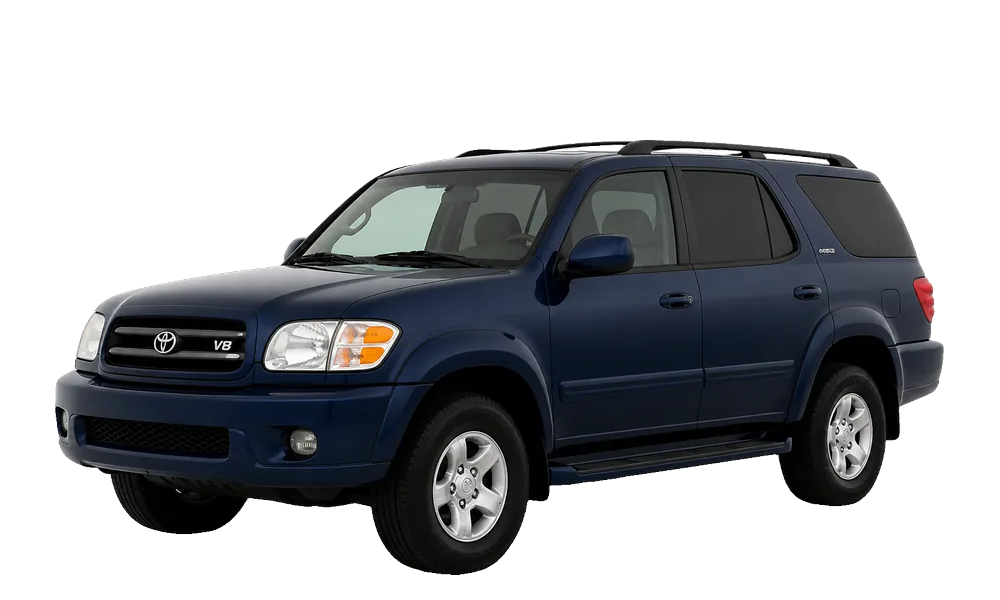 20032005
1st generation
About average · most complaints: suspension
49 owner complaints, first 3 years 14 mpg combined, EPA
Similar cars, same year
2004 Chevrolet Tahoe 1092004 Ford Expedition 792004 Chevrolet Suburban 127
Lemon Index: 100 = the average car, lower is better.
What breaks most on the 2004 Toyota Sequoia
- Rust / frame corrosion64 complaintsmostly at 100,000–173,000 miles (161,000–279,000 km)
- Ball joint / control arm21 complaintsmostly at 52,000–203,000 miles (84,000–327,000 km)
Specific parts named in the 380 owner complaints filed with NHTSA for the 2004 Toyota Sequoia (all dates). Miles = the odometer owners typed in (middle half); cost = the repair bills owners wrote in those same complaints, in U.S. dollars. Owners' reports, not confirmed defects.
When problems show up
Most problems on this year showed up between 9,000 and 51,000 miles (14,000–82,000 km) (the middle half of the 34 complaints, of all 49 filed so far, that listed a mileage).
- At 60K, 100K and 150K miles (97K, 161K and 241K km) Past the range where most problems showed up: it has likely had them or dodged them, so repair records matter most.
This is when owners who had a problem reported it, not the odds that one car will have it.
Questions to ask the seller
- Were recalls 22E002000 (suspension), 19V741000 (airbags) and 18V883000 (airbags) done? It has 9 recalls in all. Ask for the dealer printout, or check the VIN.
- NHTSA has an open investigation into desiccated air bag inflator rupture. Has this car had that problem?
- Any clunks over bumps or uneven tire wear? Were struts, shocks or control arms replaced?
- Do the brakes feel even, with no ABS or brake warning light? When were the pads and brake fluid last done?
- Do all the lights, screens and power features work? Has the battery, alternator or any wiring been replaced?
- Toyota sent dealers 167 repair notes for this car. Was this one done: “Electronic Communication: The National Highway Traffic Safety Administration (NHTSA) and TK…”?
From this year's own recalls, top problems, top repair bills and Toyota's repair notes. Recall repairs are free at any dealer.
How serious. Out of all 49 owner complaints filed so far (every year since it was sold, not just the first 3), owners reported:
“Average car” = what the same number of complaints would include at the rate across every model year we track. Owners report these themselves; NHTSA doesn't confirm the cause.
What owners complain about most. From owner complaints to the government.
Share of this year's owner complaints filed with NHTSA, not the share of cars that break. One complaint can name more than one area.
Check engine light on? Look up any code →
When owners reported problems. From owner complaints to the government.
Most owners who filed a complaint with NHTSA had 9K to 50K miles (14K to 82K km) on the car (34 of all 49 complaints filed so far listed the miles). This shows when people who had a problem reported it, not the odds that your car will have it.
In owners' words
The sequioa has been pulling and making excessive noise from the front of the vehicle. Drifiting from side to side and hard to steer.
2004 Toyota Sequoia owner · NHTSA complaint 10187169
More owner reports
Dt*: the contact stated the vehicle lost pressure with the brake pedal causing the brake warning light to illuminate. The vehicle had been to the service dealer eight times and the dealer could not locate the problem.
NHTSA complaint 10170126
Vsc control unit failure on 2004 Toyota Sequoia. The vsc off light is on as well as the check engine light. Told it is a $2000 fix by the dealer.
NHTSA complaint 10193747
Problems Toyota told dealers about
Toyota sent dealers 167 repair notes for this car. The ones about its biggest problems:
- Electronic Communication: The National Highway Traffic Safety Administration (NHTSA) and TK…
- Region Letter: The National Highway Traffic Safety Administration (NHTSA) and TK Holdings, Inc
- The technical instructions for Safety Recall DOF (Front Passenger Airbag Inflater Module) require
Ask a seller or mechanic if these were done. Some are free under warranty or a special program.
Recalls 9
- Suspension · recall issued 2022
The ball joint housing may have inadequate hardness, causing premature failure.
- Airbags · recall issued 2019
These vehicles had their driver or passenger frontal air bag inflators previously replaced under a prior recall using inflators of the same design.
- Airbags · recall issued 2018
These vehicles are equipped with certain air bag inflators assembled as part of the passenger frontal air bag modules used as original equipment or replacement equipment.
Show all 9 recalls
- Airbags · recall issued 2015
In the event of a crash necessitating deployment of the passenger's frontal air bag, the inflator could rupture with metal fragments striking the vehicle occupants potentially resulting in serious injury or death.
- Airbags · recall issued 2015
On June 16, 2015, Toyota expanded the recall to include an additional 1,270,468 vehicles, including model year 2002-2003 and 2005-2007 Sequoia, 2005-2006 Tundra, 2003-2007 Corolla, 2003-2007 Corolla Matrix, 2003-2007 Pon…
- Brakes · recall issued 2007
CERTAIN CARDONE MASTER CYLINDERS WITH PART NUMBERS 10-2925, 10-2987, 10-2987MZA, 10-3083, 11-3015, 11-3042, 11-3044, 11-3045, 11-3047, 11-3064, AND 11-3156, AND WITH DATE CODES LOWER THAN DCA7078 SOLD AS REPLACEMENT EQUI…
- Suspension · recall issued 2007
ON CERTAIN TRUCKS AND MINI VANS, DUE TO POSSIBLE IMPROPER FINISHING OF THE FRONT SUSPENSION LOWER BALL JOINT, SOME BALL JOINTS MAY EXPERIENCE AN INCIDENTAL DETERIORATION OF THE INTERNAL LUBRICATION.
- Lights · recall issued 2006
CERTAIN CK MOTORSPORTS COMBINATION HEADLIGHTS, CLEAR CORNER, BUMPER, AND SIDE MARKER LIGHTS SOLD AS REPLACEMENT LAMPS FOR USE ON THE PASSENGER VEHICLES LISTED ABOVE.
- Suspension · recall issued 2005
ON CERTAIN SPORT UTILITY VEHICLES, DUE TO A MANUFACTURING ISSUE IN THE FRONT SUSPENSION LOWER BALL JOINT, THERE IS A POSSIBILITY THAT THE SURFACE OF THE BALL OF THE JOINT MAY HAVE BEEN SCRATCHED.
Recall repairs are free at any dealer. A recall only matters if it's still open on that exact car, so check its VIN.
Canada? See recalls at Transport Canada
Government investigations
- OpenDesiccated air bag inflator rupture2021
- OpenAir bag inflator rupture2015
- ClosedAir bag inflator rupture2014–2015
- ClosedLower ball joint failure2006–2007
NHTSA looks into a problem when enough owners report it. Many end in a recall.
Safety
Crash stars (older test): front ★★★★★ · side — · rollover —
Fuel cost and engines
About $4,300 (USD) a year in fuel (EPA estimate at U.S. prices, 15,000 miles or 24,000 km a year). Engines: 4.7L 8-cyl.
Every Toyota Sequoia year. 2004 is highlighted. Lower is better.
Newest year first. Red = worse than average, gray = about average, too new (2023+: a partial score, marked “partial”) or too few complaints to score.
Embed this chart
Put this chart on your site, blog or forum. Free, with the credit line built in; the 2004 bar is highlighted.
<iframe src="https://lemonindex.com/embed/cars/toyota-sequoia/?y=2004" title="Toyota Sequoia reliability by model year (The Lemon Index)" width="100%" height="445" style="border:0;max-width:720px" loading="lazy"></iframe><p style="font-size:13px;margin:4px 0 0">Data: <a href="https://lemonindex.com/cars/toyota-sequoia/2004/">Lemon Index</a> (2004 Toyota Sequoia reliability)</p>Quick answers
Is the 2004 Toyota Sequoia reliable?
About average by government complaints. It drew about the average number of complaints filed with NHTSA in its first 3 years, per car sold (Lemon Index 99; 100 is average, lower is better). The Toyota Sequoia year with the fewest complaints per car sold since 2010 is 2010.
What are the most common 2004 Toyota Sequoia problems?
In owner complaints to the government, the parts named most are suspension (29%), brakes (24%) and electrical (16%). That is the share of complaints, not the share of cars that break.
How many recalls does the 2004 Toyota Sequoia have?
9 safety recalls (latest: suspension). Recall repairs are free at any dealer; check a specific car's VIN at nhtsa.gov/recalls.
What gas mileage does the 2004 Toyota Sequoia get?
14 mpg combined, depending on the engine (EPA estimate).
At what mileage do 2004 Toyota Sequoia problems show up?
Most problems on this year showed up between 9,000 and 51,000 miles (14,000–82,000 km) (the middle half of the 34 complaints, of all 49 filed so far, that listed a mileage). At 60K, 100K and 150K miles, a 2004 is past the range where most problems showed up: it has likely had them or dodged them, so repair records matter most. This is when owners who had a problem reported it, not a prediction for one car.
Does the 2004 Toyota Sequoia have transmission problems?
Transmission and drivetrain issues make up 8% of its owner complaints.
How much does the 2004 Toyota Sequoia cost in fuel a year?
About $4,300 a year, by the EPA's current estimate.
What engines does the 2004 Toyota Sequoia have?
4.7L 8-cyl.
What Toyota Sequoia year is better than the 2004?
Nearby, the 2001 drew fewer owner complaints per car sold (somewhat fewer complaints than the average car). Across every year, 2010 drew the fewest.
The Lemon Index counts owner complaints filed with the U.S. government (NHTSA) in a car's first 3 years, per car sold, against the average car of the same model years (100 = average, lower is better). It measures complaints, not crash safety. A complaint is an owner's report, not a confirmed defect. How it works