 The Lemon Index
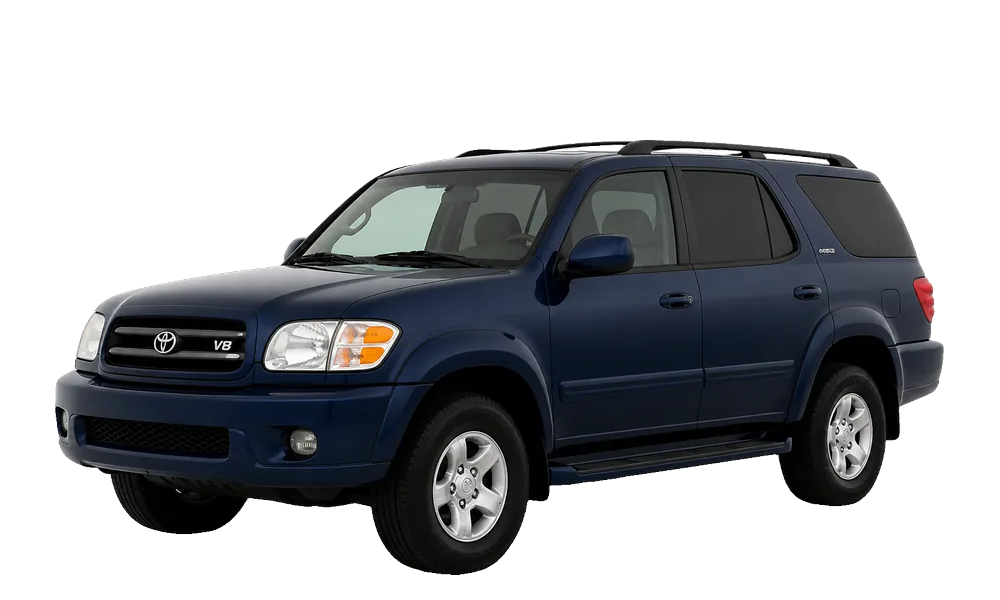 20022004
1st generation
Worse than average · most complaints: brakes
73 owner complaints, first 3 years 14 mpg combined, EPA
Similar cars, same year
2003 Chevrolet Tahoe 722003 Ford Expedition 1722003 Chevrolet Suburban 108
Lemon Index: 100 = the average car, lower is better.
What breaks most on the 2003 Toyota Sequoia
- Rust / frame corrosion93 complaintsmostly at 103,000–185,000 miles (166,000–298,000 km)
- Engine stalling23 complaintsmostly at 56,000–105,000 miles (90,000–169,000 km)
Specific parts named in the 671 owner complaints filed with NHTSA for the 2003 Toyota Sequoia (all dates). Miles = the odometer owners typed in (middle half); cost = the repair bills owners wrote in those same complaints, in U.S. dollars. Owners' reports, not confirmed defects.
When problems show up
Most problems on this year showed up between 8,000 and 45,000 miles (13,000–72,000 km) (the middle half of the 46 complaints, of all 73 filed so far, that listed a mileage).
- At 60K, 100K and 150K miles (97K, 161K and 241K km) Past the range where most problems showed up: it has likely had them or dodged them, so repair records matter most.
This is when owners who had a problem reported it, not the odds that one car will have it.
Questions to ask the seller
- Were recalls 19V741000 (airbags), 18V883000 (airbags) and 15V286000 (airbags) done? It has 7 recalls in all. Ask for the dealer printout, or check the VIN.
- NHTSA has an open investigation into desiccated air bag inflator rupture. Has this car had that problem?
- Do the brakes feel even, with no ABS or brake warning light? When were the pads and brake fluid last done?
- Do all the lights, screens and power features work? Has the battery, alternator or any wiring been replaced?
- Any oil burning, leaks or check-engine lights? Ask for oil-change records.
- Toyota sent dealers 164 repair notes for this car. Was this one done: “Abnormal squeal noise from the engine accessory drive belt area, usually during cold start-up”?
From this year's own recalls, top problems, top repair bills and Toyota's repair notes. Recall repairs are free at any dealer.
How serious. Out of all 73 owner complaints filed so far (every year since it was sold, not just the first 3), owners reported:
“Average car” = what the same number of complaints would include at the rate across every model year we track. Owners report these themselves; NHTSA doesn't confirm the cause.
What owners complain about most. From owner complaints to the government.
Share of this year's owner complaints filed with NHTSA, not the share of cars that break. One complaint can name more than one area.
Check engine light on? Look up any code →
When owners reported problems. From owner complaints to the government.
Most owners who filed a complaint with NHTSA had 8K to 44K miles (13K to 72K km) on the car (46 of all 73 complaints filed so far listed the miles). This shows when people who had a problem reported it, not the odds that your car will have it.
In owners' words
The vsc and brake lights on our Toyota seqouia 2003( 4wd ltd, 9000 miles) comes on without warning and goes off usually when the ignition is turned off. The cars seem to handle fine but I am concerned for our safety.
2003 Toyota Sequoia owner · NHTSA complaint 10121651
More owner reports
Inadequate braking, interior noises, oil pressure gauge.
NHTSA complaint 10050937
The anti-skid control engaged when the consumer was driving on dry pavement under 25 mph
NHTSA complaint 10019482
Problems Toyota told dealers about
Toyota sent dealers 164 repair notes for this car. The ones about its biggest problems:
- Abnormal squeal noise from the engine accessory drive belt area, usually during cold start-up
- Accelerator pedal sensor assembly information regarding the inspection, removal, and…
- Electronic Communication: The National Highway Traffic Safety Administration (NHTSA) and TK…
Ask a seller or mechanic if these were done. Some are free under warranty or a special program.
Recalls 7
- Airbags · recall issued 2019
These vehicles had their driver or passenger frontal air bag inflators previously replaced under a prior recall using inflators of the same design.
- Airbags · recall issued 2018
These vehicles are equipped with certain air bag inflators assembled as part of the passenger frontal air bag modules used as original equipment or replacement equipment.
- Airbags · recall issued 2015
In the event of a crash necessitating deployment of the passenger's frontal air bag, the inflator could rupture with metal fragments striking the vehicle occupants potentially resulting in serious injury or death.
Show all 7 recalls
- Airbags · recall issued 2015
On June 16, 2015, Toyota expanded the recall to include an additional 1,270,468 vehicles, including model year 2002-2003 and 2005-2007 Sequoia, 2005-2006 Tundra, 2003-2007 Corolla, 2003-2007 Corolla Matrix, 2003-2007 Pon…
- Stability control · recall issued 2010
TOYOTA IS RECALLING CERTAIN MODEL YEAR 2003 SEQUOIA PASSENGER VEHICLES MANUFACTURED FROM APRIL 1, 2002 THROUGH APRIL 17, 2003.
- Lights · recall issued 2006
CERTAIN CK MOTORSPORTS COMBINATION HEADLIGHTS, CLEAR CORNER, BUMPER, AND SIDE MARKER LIGHTS SOLD AS REPLACEMENT LAMPS FOR USE ON THE PASSENGER VEHICLES LISTED ABOVE.
- Suspension · recall issued 2005
ON CERTAIN SPORT UTILITY VEHICLES, DUE TO A MANUFACTURING ISSUE IN THE FRONT SUSPENSION LOWER BALL JOINT, THERE IS A POSSIBILITY THAT THE SURFACE OF THE BALL OF THE JOINT MAY HAVE BEEN SCRATCHED.
Recall repairs are free at any dealer. A recall only matters if it's still open on that exact car, so check its VIN.
Canada? See recalls at Transport Canada
Government investigations
- OpenDesiccated air bag inflator rupture2021
- OpenAir bag inflator rupture2015
- ClosedAir bag inflator rupture2014–2015
- ClosedElectronic stability control2009–2010
NHTSA looks into a problem when enough owners report it. Many end in a recall.
Safety
Crash stars (older test): front ★★★★★ · side — · rollover ★★★☆☆
Fuel cost and engines
About $4,300 (USD) a year in fuel (EPA estimate at U.S. prices, 15,000 miles or 24,000 km a year). Engines: 4.7L 8-cyl.
Every Toyota Sequoia year. 2003 is highlighted. Lower is better.
Newest year first. Red = worse than average, gray = about average, too new (2023+: a partial score, marked “partial”) or too few complaints to score.
Embed this chart
Put this chart on your site, blog or forum. Free, with the credit line built in; the 2003 bar is highlighted.
<iframe src="https://lemonindex.com/embed/cars/toyota-sequoia/?y=2003" title="Toyota Sequoia reliability by model year (The Lemon Index)" width="100%" height="445" style="border:0;max-width:720px" loading="lazy"></iframe><p style="font-size:13px;margin:4px 0 0">Data: <a href="https://lemonindex.com/cars/toyota-sequoia/2003/">Lemon Index</a> (2003 Toyota Sequoia reliability)</p>Quick answers
Is the 2003 Toyota Sequoia reliable?
No, it is worse than average by government complaints. It drew a bit more than the average car's complaints filed with NHTSA in its first 3 years, per car sold (Lemon Index 134; 100 is average, lower is better). The Toyota Sequoia year with the fewest complaints per car sold since 2010 is 2010.
What are the most common 2003 Toyota Sequoia problems?
In owner complaints to the government, the parts named most are brakes (27%), electrical (15%) and engine (12%). That is the share of complaints, not the share of cars that break.
How many recalls does the 2003 Toyota Sequoia have?
7 safety recalls (latest: airbags). Recall repairs are free at any dealer; check a specific car's VIN at nhtsa.gov/recalls.
What gas mileage does the 2003 Toyota Sequoia get?
14 mpg combined, depending on the engine (EPA estimate).
At what mileage do 2003 Toyota Sequoia problems show up?
Most problems on this year showed up between 8,000 and 45,000 miles (13,000–72,000 km) (the middle half of the 46 complaints, of all 73 filed so far, that listed a mileage). At 60K, 100K and 150K miles, a 2003 is past the range where most problems showed up: it has likely had them or dodged them, so repair records matter most. This is when owners who had a problem reported it, not a prediction for one car.
Does the 2003 Toyota Sequoia have transmission problems?
Transmission and drivetrain issues aren't among its top 5 complaint areas.
How much does the 2003 Toyota Sequoia cost in fuel a year?
About $4,300 a year, by the EPA's current estimate.
What engines does the 2003 Toyota Sequoia have?
4.7L 8-cyl.
What Toyota Sequoia year is better than the 2003?
Nearby, the 2001 drew fewer owner complaints per car sold (somewhat fewer complaints than the average car). Across every year, 2010 drew the fewest.
The Lemon Index counts owner complaints filed with the U.S. government (NHTSA) in a car's first 3 years, per car sold, against the average car of the same model years (100 = average, lower is better). It measures complaints, not crash safety. A complaint is an owner's report, not a confirmed defect. How it works