 The Lemon Index
 20162018
2nd generation
23 owner complaints, first 3 years 22–25 mpg combined, EPA
Similar cars, same year
2017 Lexus RX 392017 Acura MDX 1022017 BMW X5 50
Lemon Index: 100 = the average car, lower is better.
What breaks most on the 2017 Volvo XC90
- Engine stalling9 complaints
Specific parts named in the 82 owner complaints filed with NHTSA for the 2017 Volvo XC90 (all dates). Miles = the odometer owners typed in (middle half); cost = the repair bills owners wrote in those same complaints, in U.S. dollars. Owners' reports, not confirmed defects.
When problems show up
Most problems on this year showed up between 7,500 and 20,000 miles (12,000–32,000 km) (the middle half of the 21 complaints, of all 23 filed so far, that listed a mileage).
- At 60K, 100K and 150K miles (97K, 161K and 241K km) Past the range where most problems showed up: it has likely had them or dodged them, so repair records matter most.
This is when owners who had a problem reported it, not the odds that one car will have it.
Questions to ask the seller
- Were recalls 23V827000 (seat belts), 21V273000 (electrical) and 18V800000 (electrical) done? It has 7 recalls in all. Ask for the dealer printout, or check the VIN.
- Any oil burning, leaks or check-engine lights? Ask for oil-change records.
- Do the brakes feel even, with no ABS or brake warning light? When were the pads and brake fluid last done?
- Any rust or damage underneath, or doors and hatches that don't close right?
- Volvo sent dealers 698 repair notes for this car. Was this one done: “This is a technical journal: condensation water, transferred through the airconditioning drain…”?
From this year's own recalls, top problems, top repair bills and Volvo's repair notes. Recall repairs are free at any dealer.
How serious. Out of all 23 owner complaints filed so far (every year since it was sold, not just the first 3), owners reported:
“Average car” = what the same number of complaints would include at the rate across every model year we track. Owners report these themselves; NHTSA doesn't confirm the cause.
What owners complain about most. From owner complaints to the government.
Share of this year's owner complaints filed with NHTSA, not the share of cars that break. One complaint can name more than one area.
Check engine light on? Look up any code →
When owners reported problems. From owner complaints to the government.
Most owners who filed a complaint with NHTSA had 7K to 20K miles (12K to 32K km) on the car (21 of all 23 complaints filed so far listed the miles). This shows when people who had a problem reported it, not the odds that your car will have it.
In owners' words
Leak in radiator hose caused car to loose enough water in radiator to cause alarm
2017 Volvo XC90 owner · NHTSA complaint 11288054
Problems Volvo told dealers about
Volvo sent dealers 698 repair notes for this car. The ones about its biggest problems:
- This is a technical journal: condensation water, transferred through the airconditioning drain…
- If symptom of noise occurs from the rear brakes during braking follow advice under service
- This document is a Technical Journal: A rattling noise may occur while closing thefront door…
Ask a seller or mechanic if these were done. Some are free under warranty or a special program.
Recalls 7
- Seat belts · recall issued 2023
The second-row seat belt buckle and lower belt anchor bolts may not be tightened properly.
- Electrical · recall issued 2021
Liquid or condensation on the rear seat control display may cause the front passenger seat to move back as far as possible.
- Electrical · recall issued 2018
The software installed in the Vehicle Connectivity Module (VCM) may have an error causing the Telematics and Driver Support Systems to function improperly.
Show all 7 recalls
- Seat belts · recall issued 2017
The Micro Gas Generator (MGG), a subcomponent part used within the right hand side seat belt retractor for the third row seats, may detach after the seatbelt retractor pretensioner is deployed.
- Airbags · recall issued 2017
The bolts that secure the Inflatable Curtain (IC) air bags in place may break, possibly resulting in the IC air bag deploying improperly in the event of a crash.
- Seat belts · recall issued 2016
On the affected vehicles, the front passenger seat belt buckle attaching stud may loosen, allowing the buckle to separate from the seat belt bracket.
- Equipment · recall issued 2016
In the affected vehicles, the drain hose for the air conditioning may leak into the passenger compartment due to a drain hose installation error during manufacturing.
Recall repairs are free at any dealer. A recall only matters if it's still open on that exact car, so check its VIN.
Canada? See recalls at Transport Canada
Government investigations
- ClosedPedestrian alert sounds2023
NHTSA looks into a problem when enough owners report it. Many end in a recall.
Safety
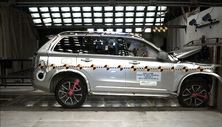
Crash test details
| Version | Overall | Front | Side | Rollover |
|---|---|---|---|---|
| Volvo XC90 T5 SUV FWD | not rated | ★★★★★ | ★★★★★ | not rated |
| Volvo XC90 T5 SUV AWD | ★★★★★ | ★★★★★ | ★★★★★ | ★★★★☆ |
| Volvo XC90 T6 SUV FWD | not rated | ★★★★★ | ★★★★★ | not rated |
| Volvo XC90 T6 SUV AWD | ★★★★★ | ★★★★★ | ★★★★★ | ★★★★☆ |
Fuel cost and engines
About $3,000–$3,400 (USD) a year in fuel (EPA estimate at U.S. prices, 15,000 miles or 24,000 km a year). Engines: 2.0L 4-cyl.
Every Volvo XC90 year. 2017 is highlighted. Lower is better.
Newest year first. Red = worse than average, gray = about average, too new (2023+: a partial score, marked “partial”) or too few complaints to score.
Embed this chart
Put this chart on your site, blog or forum. Free, with the credit line built in; the 2017 bar is highlighted.
<iframe src="https://lemonindex.com/embed/cars/volvo-xc90/?y=2017" title="Volvo XC90 reliability by model year (The Lemon Index)" width="100%" height="514" style="border:0;max-width:720px" loading="lazy"></iframe><p style="font-size:13px;margin:4px 0 0">Data: <a href="https://lemonindex.com/cars/volvo-xc90/2017/">Lemon Index</a> (2017 Volvo XC90 reliability)</p>Quick answers
Is the 2017 Volvo XC90 reliable?
Yes, better than average by government complaints. It drew a bit over half as many complaints as the average car filed with NHTSA in its first 3 years, per car sold (Lemon Index 61; 100 is average, lower is better). The Volvo XC90 year with the fewest complaints per car sold since 2010 is 2019.
What are the most common 2017 Volvo XC90 problems?
In owner complaints to the government, the parts named most are engine (35%), brakes (22%) and body structure (13%). That is the share of complaints, not the share of cars that break.
How many recalls does the 2017 Volvo XC90 have?
7 safety recalls (latest: seat belts). Recall repairs are free at any dealer; check a specific car's VIN at nhtsa.gov/recalls.
What gas mileage does the 2017 Volvo XC90 get?
22 to 25 mpg combined, depending on the engine (EPA estimate).
Is the 2017 Volvo XC90 safe?
NHTSA gave it 5 out of 5 stars overall in its best tested version. Ratings differ by body style, and the full table is on the advanced page.
At what mileage do 2017 Volvo XC90 problems show up?
Most problems on this year showed up between 7,500 and 20,000 miles (12,000–32,000 km) (the middle half of the 21 complaints, of all 23 filed so far, that listed a mileage). At 60K, 100K and 150K miles, a 2017 is past the range where most problems showed up: it has likely had them or dodged them, so repair records matter most. This is when owners who had a problem reported it, not a prediction for one car.
Does the 2017 Volvo XC90 have transmission problems?
Transmission and drivetrain issues aren't among its top 5 complaint areas.
How much does the 2017 Volvo XC90 cost in fuel a year?
About $3,000 to $3,400 a year, by the EPA's current estimate.
What engines does the 2017 Volvo XC90 have?
2.0L 4-cyl.
What Volvo XC90 year is better than the 2017?
Nearby, the 2019 drew fewer owner complaints per car sold (about a fifth as many complaints as the average car).
The Lemon Index counts owner complaints filed with the U.S. government (NHTSA) in a car's first 3 years, per car sold, against the average car of the same model years (100 = average, lower is better). It measures complaints, not crash safety. A complaint is an owner's report, not a confirmed defect. How it works